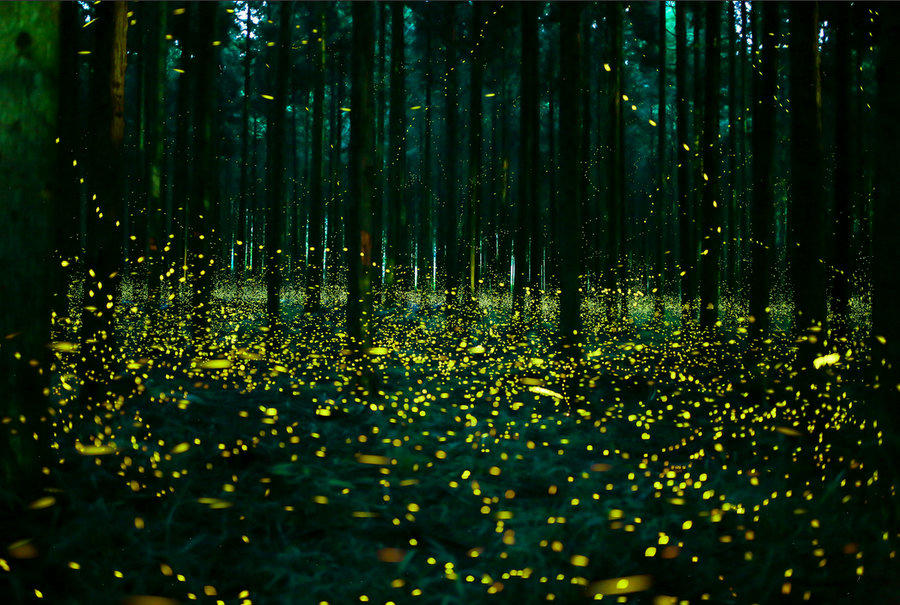
A flickering light in the night, fireflies have had a mysticism about them that makes the imagination run wild. Throughout the ages, they have been viewed very differently in cultures around the world. Long ago in China fireflies were thought of as a product of burning grasses and so a favorite pastime was to catch these fireflies and put them in a box to function like a lantern. In Japan they were thought to be the souls of the dead, possibly those of soldiers who died in battle. They also inspired superstition in the Victorian Era where it was believed that if you found a firefly in your house, it meant that someone was going to die soon. Today, everyone knows Owl City’s classic song “Fireflies”, but how much do you really know about fireflies?
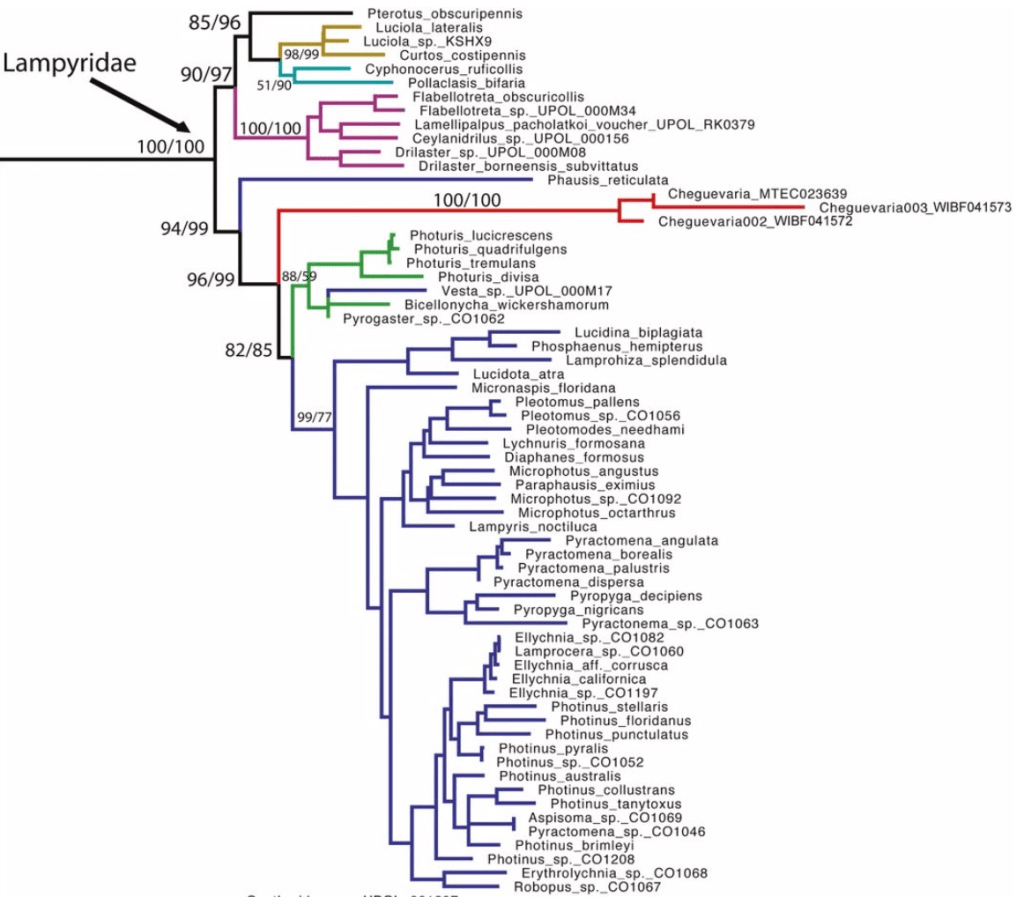
Did you know that fireflies aren’t actually flies, but beetles? In scientific classification all fireflies are classified under the family Lampyridae. Under this family there are over 2,000 distinct species listed under six subfamilies: Cyphonocerinae, Lampyrinae, Luciolinae, Photurinae, Cheguevariinae, and Ototretinae. The last one of these, however, is currently disputed as to whether it is an actual separate subfamily. Below is a phylogenetic tree of the Lampyridae family.
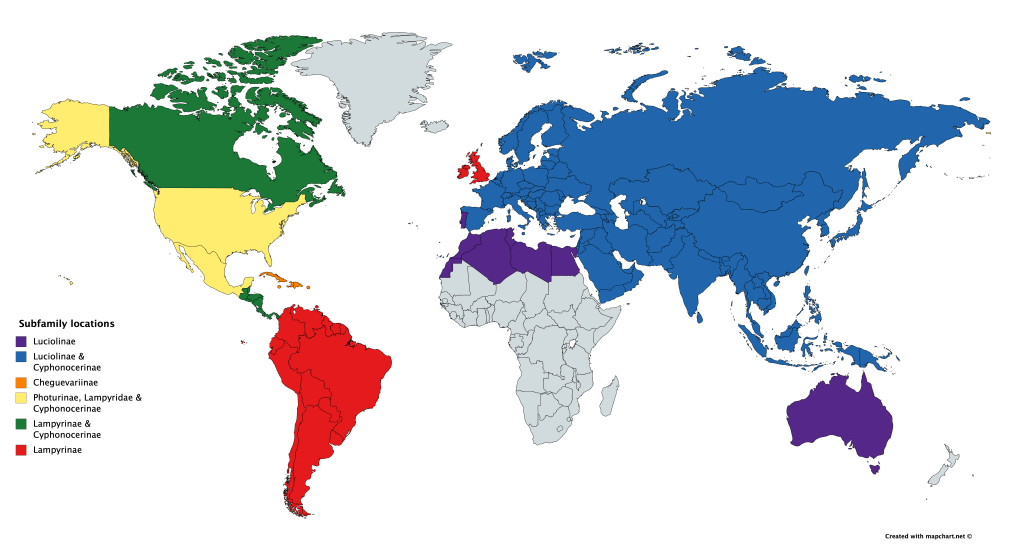
Fireflies have been found on every continent except Antarctica, as seen in the map below, showing where each subfamily is present.
All stages of the firefly’s life have been reported to glow in the majority of species. They spend their entire lives in moist climates. Fireflies begin their lives as eggs laid in midsummer. A female adult firefly lays around 100 eggs either singly or in clusters. After 2 to 3 weeks, the eggs hatch. These larvae gain nutrients by nocturnally hunting for snails and worms. The larvae catch their prey by ejecting intestinal paralyzing juices onto the prey and absorb their catch once partially digested. During winter, they hibernate close to the ground under stones or in specially constructed chambers.
After 1 or 2 winters, the larvae finally pupate. Some species of fireflies create pupal cells or mud chambers and other species hang from trees like caterpillars in lattice-like dome structures. The process lasts approximately 3 weeks.
The adult stage of a firefly’s life is extremely short, lasting only 3 to 4 weeks. The sole purpose of this stage is to reproduce, leaving little to no time for eating. What most species consume, if anything, is unknown but thought to be plant pollen or nectar. The females of one species has been observed to mimic the light pattern of another species to lure the males in as prey. Depending on the species, males or females attract their mates by species-specific light patterns. The glow can also be used to warn other fireflies of imminent dangers to survival. If a female decides to mate with a male, her eggs are internally fertilized then laid at the roots of moist moss or grass.
Fireflies are a far more diverse and interesting group of insects than many realize. The bright lights seen floating through the warm air of summer nights are merely the fleeting final chapter of this animals life cycle. The diverse speciation of these animals and the broad geological range that they inhabit leaves much to be said about their resilience and proliferation. Many people know nothing about fireflies beyond their glow, but these creatures have many interesting facts waiting to be told! If reading this post has piqued your interest in these illuminatory insects, you are in luck! In future blogs, we will dive into more interesting facts about these truly fascinating animals.
Follow My Blog!
Get new content delivered directly to your inbox.
 Lampyridae - Fireflies